
XK70
- 9.4 in
- 26.2°
- 12,000 lb
XK70 specs →
Third generation (XK70) · 2022–present
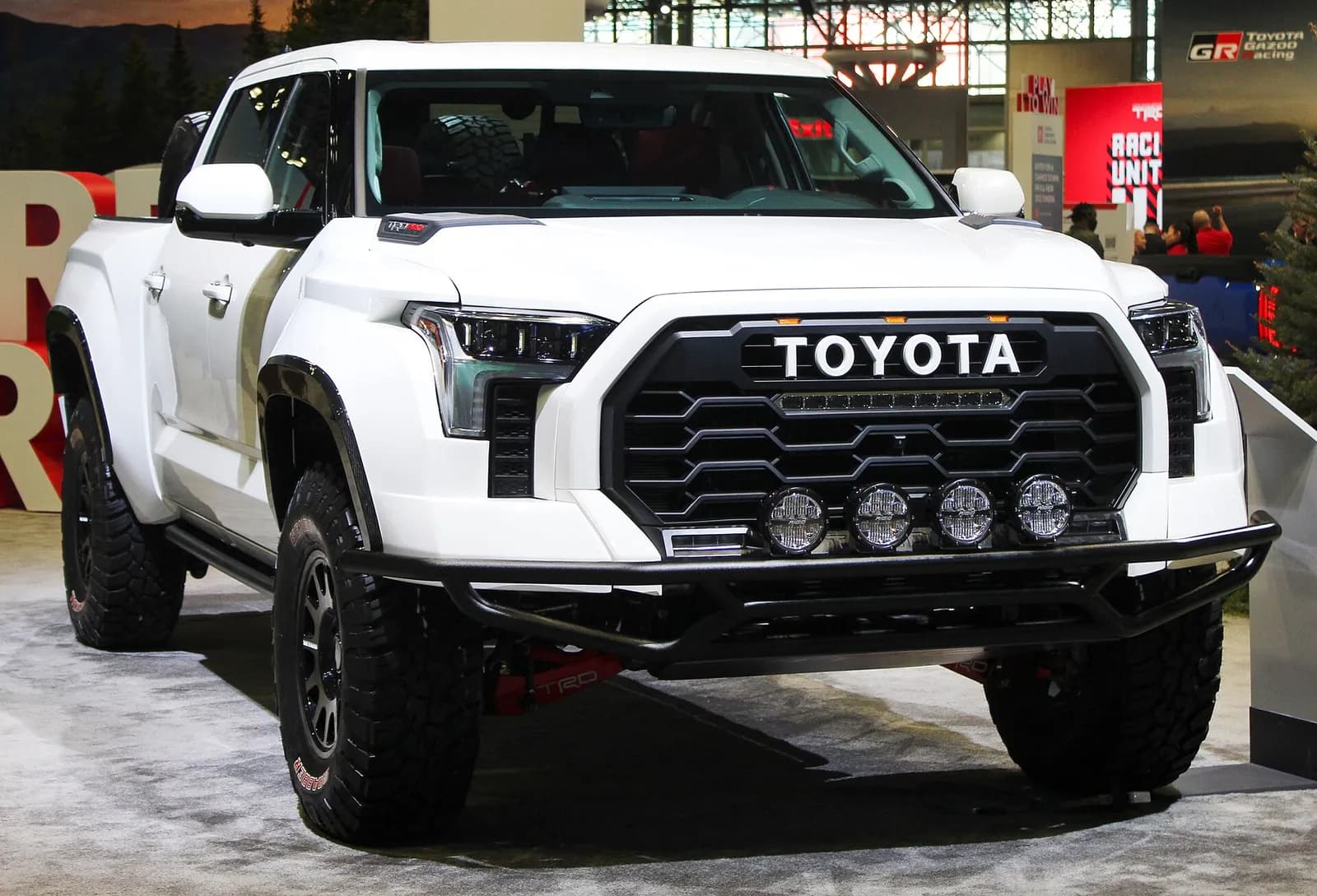
The 2026 Toyota Tundra has up to 9.4 in of ground clearance (Limited) and an approach angle of up to 26.2° (TRD Pro). It is rated to tow up to 12,000 lb (SR5 Double Cab 6.5-ft bed 4x2).
MakerSource: 2026 Tundra Product Information
Documents last checked .
01 / Everything on one page
02 / Quick specs
03 / Class
9.4
26.2°
24.2°
Higher than 30% of the 20 pickups we track.
12,000
1,940
04 / Spec plate
Spec plate
One configuration per trim, named under each heading, with its numbers as Toyota prints them. “Up to” is a ceiling printed over several configurations (the notes say whose), “from” the lowest figure, and a range is printed across that configuration’s grades. “Door label” means the maker prints it only on each vehicle’s certification label.
Estimate ±A dashed underline marks our estimate where Toyota prints no figure: worked out from its other numbers, shown with its margin (±), and never used for a headline, comparison or ranking.
| SRSR Double Cab 6.5-ft bed 4x4 | SR5SR5 Double Cab 6.5-ft bed 4x4 | LimitedLimited CrewMax 5.5-ft bed 4x4 | PlatinumPlatinum CrewMax 5.5-ft bed 4x4 i-FORCE MAX | 1794 EditionEdition CrewMax 5.5-ft bed 4x4 i-FORCE MAX | TRD ProTRD Pro CrewMax 5.5-ft bed 4x4 i-FORCE MAX | CapstoneCapstone CrewMax 6.5-ft bed 4x4 i-FORCE MAX | |
|---|---|---|---|---|---|---|---|
| Off-road | |||||||
| Ground clearance | — | 9.3 in | 9.4 in | 8.5 in | 8.5 in | 9.0 in | 8.5 in |
| Approach angle | 21.0° | 21.0° | 21.0° | 21.0° | 21.0° | 26.2° | 21.0° |
| Breakover angle | — | 18.9° ±6.0° | 19.1° ±6.0° | 17.7° ±6.0° | 17.7° ±6.0° | 18.4° ±6.0° | 16.3° ±6.0° |
| Departure angle | 24.0° | 24.0° | 24.0° | 24.0° | 24.0° | 24.2° | 24.0° |
| Dimensions and bed | |||||||
| Length | 233.6 in | 233.6 in | 233.6 in | 233.6 in | 233.6 in | 233.6 in | 245.6 in |
| Width | 80.2 in | 80.2 in | 80.2 in | 80.2 in | 80.2 in | 81.6 in | 80.2 in |
| Height | 78.0 in | 78.0 in | 78.0 in | 78.0 in | 78.0 in | 78.0 in | 78.0 in |
| Wheelbase | 145.7 in | 145.7 in | 145.7 in | 145.7 in | 145.7 in | 145.7 in | 157.7 in |
| Bed length, at the floor | 77.6 in | 77.6 in | 65.6 in | 65.6 in | 65.6 in | 65.6 in | 77.6 in |
| Bed width, between wheel wells | 48.7 in | 48.7 in | 48.7 in | 48.7 in | 48.7 in | 48.7 in | 48.7 in |
| Bed depth | 20.9 in | 20.9 in | 20.9 in | 20.9 in | 20.9 in | 20.9 in | 20.9 in |
| Weights, loads and capacities | |||||||
| Curb weight | 5,380–5,490 lb | 5,380–5,490 lb | 5,390–5,490 lb | 6,010–6,095 lb | 6,010–6,095 lb | 6,010–6,095 lb | 6,095–6,185 lb |
| GVWR | 7,265 lb | 7,265 lb | 7,230 lb | 7,230–7,780 lb | 7,230–7,780 lb | 7,230–7,780 lb | 7,230–7,780 lb |
| Max payload | 1,885 lb | 1,885 lb | 1,740 lb | 1,565 lb | 1,565 lb | 1,600 lb | 1,485 lb |
| Max towing | 8,300 lb | 11,200 lb | 11,120 lb | 11,020 lb | 11,020 lb | 11,175 lb | 10,340 lb |
| Front axle rating | 4,080 lb | 4,080 lb | 4,080 lb | — | — | — | — |
| Fuel tank | 32.2 gal | 32.2 gal | 32.2 gal | 32.2 gal | 32.2 gal | 32.2 gal | 32.2 gal |
| Off-road hardware | |||||||
| Stock tires | P245/75R18 | P265/70R18 | P265/60R20 | P265/60R20 | P265/60R20 | P285/65R18 | P265/50R22 |
| Low range | 2.64:1 | 2.64:1 | 2.64:1 | 2.64:1 | 2.64:1 | — | — |
| Rear differential | — | — | — | — | — | Electronically controlled locking rear differential | — |
05 / Generations
06 / Build it
Stock figures: 2026 Tundra Product Information. Solid outline = from the maker; dashed = our estimate, ± how far off it may be. “Up to” and “from” are the maker’s words: a ceiling or a floor, not this configuration’s exact number. Overhangs are estimated (the maker doesn’t publish them), so changed angles carry a range.
Part masses are typical, not yours. This is an estimate, not a weighbridge: weigh your rig.
07 / Questions
Up to 9.4 in, on the Limited CrewMax 5.5-ft bed 4x4. The 22 configurations of the 2026 lineup that publish it run 8.5–9.4 in.
Up to 12,000 lb, on the SR5 Double Cab 6.5-ft bed 4x2. The lowest rating in the 2026 lineup is 8,300 lb, on the SR CrewMax 5.5-ft bed 4x4.
Up to 1,940 lb, on the SR and SR5. The least is 1,485 lb, on the Capstone CrewMax 5.5-ft bed 4x4 i-FORCE MAX. Payload is everything carried on top of the vehicle’s own weight: people, cargo, accessories and a trailer’s tongue weight.
P245/75R18 on the SR, P265/70R18 on the SR5, P265/60R20 on the Limited, Platinum and 1794 Edition, P285/65R18 on the TRD Pro and P265/50R22 on the Capstone. By its size code, the P265/70R18 is about 32.6 in tall, the largest of them.
Approach 21.0–26.2° and departure 24.0–24.2° across the 33 configurations of the 2026 lineup. The steepest approach, 26.2°, is on the TRD Pro CrewMax 5.5-ft bed 4x4 i-FORCE MAX.
Its curb weight runs from 5,290 lb (SR Double Cab 8.1-ft bed 4x2) to 5,565 lb (SR5 Double Cab 8.1-ft bed 4x4). Its gross vehicle weight rating (GVWR), the most it may weigh loaded, is 6,990–7,375 lb.
Yes, on some trims. Toyota’s documents for the 2026 lineup list Automatic limited-slip differential (Auto LSD) on the 4x2 and Electronically controlled locking rear differential on the 4x4. Where it doesn’t come as standard, the documents list a locking rear differential with the TRD Off-Road Package and TRD Rally Package.
32.2 gal on every configuration of the 2026 lineup.
08 / Fitment
Toyota · Tundra
35s are a common third-generation Tundra goal, but width and offset often decide whether the tire contacts the UCA, liner or body-mount area. A narrower 35 is easier to package than a wide flotation tire.
Toyota · Tundra
37s should be treated as a complete Tundra build rather than a tire swap. Suspension height, wheel offset, trimming, bump travel and safety-system requirements need to be planned together.
Upper control arm
Front liner
Body mount area
Safety-system calibration
09 / Keep going